Reply #1:I am beginning to work on a new chapter for the ConserveLiberty Personality Division elaborating on Resilience.![[ children down hill having fun pic ]](../filters/images/children_down_hill_having_fun_cr640_360.jpg)
That chapter may be one of the most complex chapters I've ever attempted. I am considering that one of the sections of this chapter on the Resilience Personality Ensemble will be called "Re-finding Me, Cognition Healing Unfolds".
The concept of "Resilience" will be developed using several examples from nature ... from The Living through All That Is. And yet, I haven't come up with the words or thoughts yet that will tie them all together. Other than that I "know" that they do, so I hope that I will.
It is because of our conversations regarding the experiences and rehabilitation journeys of those with brain injury and those who work with them that I am reaching out to you. The Cognition Healing section. The other sections I am working out independently.
I would like to send you an email every now and then. In each will be Two Things, randomly picked. Perhaps related, perhaps not. For you to read, or to ignore. If you reply, please focus on whatever you'd like.
Today's Thing One:Be candid. I'm wondering what you think. Looking forward,
Phineas P. Gage (1823 - 1860) - perhaps the most famous personality change recorded in written history after a traumatic brain injury (TBI). Or not.
Today's Thing Two:
What role do you think the brain's Reward System might have had in influencing how (or why) your rehab activities either promoted or retarded (or both!) your patients' progress?
Me.
P.S. - Today's Bonus Thing: Profanity vs. Prayer
→ Note #1 to Sophia was last updated 25 Feb 2018 09:00 PST ←
Dear David,
In regards to Thing One: There are many written accounts, even those written by traumatic brain injury (TBI) survivors describing their own personality changes. He may not be the "first", but Phineas Gage may have the "First" distinction for Fame.Note #2:
One of my first clients in San Francisco was a construction worker who suffered a TBI from a nail gun depositing a nail in his head. Amazing what he reported to me about the accident. He was walking/talking like Gage and had more delayed onset of impairments (presumeably from swelling in the brain as time went on.)
Thing Two is much deeper and really gets my mind working. The Reward System initiates from deep in the brain so it likely isn't typically directly damaged but possibly the pathways to, for example, the frontal lobe may be damaged. Additionally, as poor insight is a hallmark of TBI, if a survivor doesn't recognize any impairments or "issues" then there is nothing for them to get "rewarded" about.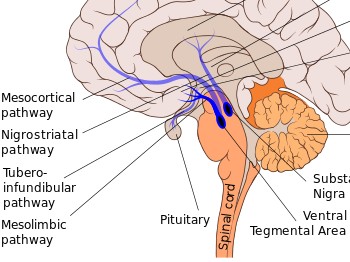
The mesolimbic pathway - the blue projections from
the VTA to the nucleus accumbens.
That is why among my initial steps in therapy I always include tasks to gently let clients "fail safely" within their familiar environment to create some tangible awareness of their functional deficit/s. That's why the Home and Community model is so awesome and gets great results. If someone fails on an unfamiliar task in an unfamiliar setting how can we expect them to translate their deficit into their Real World?
Can you remember one of your "Fail Safely" moments? I recall a trip to Costco where you had made a list but still forgot some items on it because you didn't check the list. One of your "familiar" skills prior to your TBI involved a great memory that would remember the entire list just from the act of writing it down. You had to see for yourself that your old approach wasn't working anymore, accept this was the case, and then establish a new strategy to be successful on your next trip. There are many steps that one must go through to get to the "successful" stage:This is essentially a very broad description of my approach to cognitive therapy, especially with TBI survivors. The most difficult part for therapist can be creating/recreating comparable experiences to "prove" the breakdowns and/or successes. A solid analogy freshly formed is my best defense when I'm trying to educate!
- Experience a breakdown.
- Recognize the breakdown.
(Therapist recognizes first and points it out. Next stage is TBI survivor recognizes it independently)
- Accept the deficit.
- Identify strategies (internal and/or external) to support the deficit.
(Therapist identifies strategies first typically. Next stage is TBI survivor strategizes independently.)
- Encounter same or similar experience and successfully implement strategies.
(Typically with therapist support initially and finally independently.)
Back to the Reward Center: I believe that there are times when pathways involving the Reward System are damaged. Damaged pathways combined with not having the right "circumstances" to trigger Reward Center pathway "detours" could very well result in a poor recovery progress. Obviously there are many other factors, but if you can get the Reward System to kick in at:Fun conversation for tonight, David!
- #2 - Awesome! Now you know you've got an issue! Or ...
- #4 - Nice! You've figured out how to not let that issue happen again!
Now you just need to implement it next time something similar happens. Or ...
- #5 - Ding! Ding! Ding! You did it!
You successfully worked around that issue on your own!
Now you are "cooking with gas" - and that Reward System lets you feel the success.
Sophia
P.S. Nobody loves a four letter word more than me!
→ Reply #1 to David Apollo was last updated 25 Feb 2018 18:30 PST ←
Hi Sophia,
Two responses to your last insights:Reply #2:Two more unrelated (or not) things for your Monday:
- ) AWESOME! What you revealed from your perspective and experience was different from the range of "what I was aware of" from mine. I totally enjoy new and credible perspectives.
- ) I actually hadn't considered damage to the Reward Center in my question to you. Not sure how I could have missed that! Your perspectives, coming from different experiences than mine, are a wonderful serendipity. Certainly, "two biases attempting to be unbiased" is better than one!
Monday's Thing One: Earlier you had spoken about "Uncovering The Old New Me." That is great terminology. It should mean exactly what you meant it to mean. We Change, naturally so. And in healing, change happens - change MUST happen!![[ beyond what you know pic ]](../filters/images/beyond_what_you_know_ed_recr_240_320.jpg)
Question - The "Old/New Me" that you encounter during your time with your patients (partners): Is the New consistent with the Old?, Has it developed from the same foundation that the "Old Me" has? Or is the New different from the Old. Have you seen both?
Monday's Thing Two: There are so many different manifestations of TBI, the people impacted, the recovery possible. Thinking biologically (you pick, any trait) have you noticed anything that tends to show a pattern with respect to rehab progress? Not an "all or nothing" pattern, but a "likelihood" pattern? For example (just an example, pick any other trait you want,) have you found that females generally rehab differently than males? Or that different ethnic or racial groups rehab differently?
Any pattern you've recognized that moves you to respond is the one I'm curious about. Could be hair color, size, smell (!), demeanor, anything at all.
Heading to the Mountains,
David
P.S. - Today's Bonus Thing: Two of Me
→ Note #2 to Sophia was last updated 25 Feb 2018 20:00 PST ←
Hi David,
"Is the New consistent with the Old, or different from the Old, or both?"Note #3:
I have definitely seen both. Mostly due to the severity of the brain damage.
Compared to those with a mild TBI, those that have severe damage cannot be "themselves" initially. Their friends, family, and the specialists with them find, once (if) they come out of their coma, that so much has been "lost". With time one may almost see a "fog lifting," initially, with just alertness. Later on that "fog lifts a little more" with their personality, their "Me".
The Ranchos Los Amigos Scale is typically dead on with the stages of TBI, although the speed with which one goes through the stages varies.
What I have noticed quite often is that those who had loved to learn before their accident, who were "tenacious," and are what I would consider "smart" improve more during the rehabilitation process.
→ Reply #2 to David Apollo from Sophia was last updated 27 Feb 2018 12:45 PST ←
Hi again Sophia,
I was surprised earlier that you had remembered a specific memory deficit that I had after my TBI and that it had occurred to me to try leveraging behaviors that worked for me 40+ years prior!Reply #3:
Which brings us to Tuesday's Thing One - "Relationship" and its impact on Rehab:
... in this case TBI Rehab.
What was the first thought that occurred to you just as I brought up "Relationship?"
Tuesday's Thing Two:
The last three months were significant for more than Two things. I got in touch with Three people that I had had no contact with for 30-50 years. I spent an hour each with two of them on the phone. The third (who I had had no contact with for 50 years) - we golfed 18 holes with each other, beers during and after.![[ message in bottle pic ]](../filters/images/message_in_bottle_1000_recr_240_180.jpg)
In all 3 cases, we remarked independently that the "Other" was just the same "Other" that we had known before. What was "Me" had not changed in their mind, and what was "Thee" had not changed in mine. We had journeyed 50 years, and gained 50 years of experiences. But the "Thee" had not appeared to us to have changed at all.
All felt it was wonderful to spend time together again.
Which brings up Thing Two. Nature and Nurture. Something significant had not changed despite a helluva lot of "Environment." Let's call that Instinct for now.
Now, back to what you have experienced with TBI Rehab. You help folks Uncover (Re-find) the Old/New Me. Clearly, your impact is within the Nurture domain. What do you think you help them Uncover?
David
P.S. Today's Bonus Thing - " 'Either/or'? You're living in the past. What lives is 'both/and' ... " - written on the top of my can of Lagunitas 12th of Never Ale, enroute to Denver from Oakland.
P.P.S. Bonus Bonus Thing - Can we believe what we hear?
David
→ Note #3 to Sophia was last updated 26 Feb 2018 22:30 PST ←
Hi David,
The Relationship between therapist and TBI survivor - the one I forge with my clients - is always special. I have to convey that I care about them all the while telling them things that are usually unpleasant to hear about oneself. When my client "gets" that I care and trusts me then I know we are going to make progress. I've only had it happen twice in my career where I couldn't get to that point. One case had an added factor of drug addiction and the 2nd I just had to chalk up to "I tried my best!" :)Note #4:
Your Core Person did not change as a result of your accident. You were lucky!!!
How much "Old Me" do we work on before we transition to focusing on the "New Me"?
- Initially, I help uncover their awareness of their changes as a result of their TBI (and create our client/therapist relationship.)
- Then, I help uncover strategies/therapeutic tasks that will help them mitigate their deficits and/or return to their premorbid skills.
- The part of my job that is so fun is determining on the fly which skills to work on:
- structured tasks
- unstructured tasks
- strategies to support or try and get back to 100%??
- It's never the same day twice!
→ Reply #3 to David Apollo from Sophia was last updated 27 Feb 2018 13:00 PST ←
Hi again Sophia,
Wednesday's One Thing:Note #5:
Among the many TBI encounters you have had, I get the impression that when you encounter someone that you might regard as "Resilient" you also have correlated their ability to heal cognitively with the:![[ resilient tree 01 pic ]](../filters/images/resilient_tree_01_recr_400_300.jpg)
... that you either observed with them or that they were known to have manifested before their accident.
- tenacity,
- intelligence,
- smartness, and
- love of learning
The injuries are all so different. If one grouped the injuries based on severity (to get "apples to apples" groupings based on severity,) do the rehab outcomes that unfolded, on average, show similar correlations with respect to the behavioral abilities and perspectives that you observed coincident with Resilience?
Perhaps if approximately grouped "apples to apples" by the Ranchos Los Amigos Scale?
All things considered, "Resilience" seems to be THE TRAIT YOU PICKED (my words) as the one that correlates with rehab outcome.
Do you regard them as Resilient because they did make positive progress (recognized retrospectively) or was "Resilience" recognized before significant progress was made, and you picked up on its correlation with a statistical likelihood for rehab outcome in some way?
Thank you so much,
David
→ Note #4 to Sophia was last updated 27 Feb 2018 16:00 PST ←
Hi again Sophia,
Thursday's One Thing - Moving Forward:Reply #5:
"Despite all the polarization in plain view, this is actually an awesome time to be alive and with each other and loving each other.![[ Confident Ant pic ]](../filters/images/Self_Confidence_ant_300_171.jpg)
Just 'point the skis downhill,' and Move Forward! Enjoy!!!" - Anonymous.
What does this quote have to do with Rehab after TBI? My hunch may be - Everything.
Yes, most TBI experiences are different from each other. I appreciate how adaptable and varied your approach to rehab is as you uncover what can be uncovered of the "Old Me" as it unfolds adaptively into the "Old New Me." (If it can!) I am wondering if there is also a constant aspect. A varied approach, yet with a solid, consistent foundation?
What do you believe that Foundation, Theme, or "Included Component Always There" is?
Peace!
→ Note #5 to Sophia was last updated 01 Mar 2018 06:15 PST ←
Hi David,
My solid component is that I always exude "I CARE!" Whether I am giving positive or negative feedback, my clients must know it truly comes from a place of caring. How can one feel safe to fail (FAIL = First Attempt In Learning!) without believing it is part of the process to try?Note #6:
The true foundation is my clients must TRUST me. :) My approaches to gain their trust may vary and the implementation of therapy strategies and tasks are variable, but if someone trusts me, they won't be afraid to try, even if they don't initially see the value in what I'm asking them to do.
→ Reply #5 to David Apollo from Sophia was last updated 01 Mar 2018 07:45 PST ←
Hi again Sophia,
Reply #6:You and I come at "a same issue" (the uncovering or discovery of "Me") from slightly different perspectives and interests.![[ uncovering ancient skull pic ]](../filters/images/uncovering_ancient_skull_recr_300_225.jpg)
What is interesting is that we met as those interests intersected with each other at a unique time.
I always enjoy it when those kinds of things happen, for any of a variety of circumstances.
Friday's Two Things in One:
You have approached people in "your career" from the perspective of, "You have been built in a certain way, unique to you. Can we find that again? Why? Because I care."
I approach people in "my career" from the perspective of, "How have you been built to be? Can we understand that a little better? Why? Because I care."
I use the term "career" to mean something a little different than commonly understood. "Career" could be one's job. Instead, I use it to mean "the thing we actually like doing, by default." One's career may intersect with one's job or it may not.
In both our approaches, we truly care. In both our approaches, we are curious. Our approaches manifest themselves differently in terms of what people see us doing.
In both our approaches, we care about who "You" Are. One's hunt winds up being, "Can we find it again, including what it has evolved to?" The other's hunt winds up being, "What is it that is there? Why? How? What can it evolve to?"
I am a Validator, looking for facts if there are any that can really be found.
You are a Nurturer, using facts wherever there are any that can be found and used.
We both do what we do because we truly care. Yet, differently!
Your thoughts?
→ Note #6 to Sophia was last updated 02 Mar 2018 02:45 PST ←
Hi David,
I think you NAILED IT! Yes, you are the Validator and I am the Nurturer.Reply to Reply #6:
The question for you is: Does the person need to be "invested" in what you're trying to validate?
For me, the person must be invested in trying to understand/accept their brain injury and its resulting changes in order to then improve in the areas they feel need improving.
(Remember, people occasionally discover changed behaviors that they appreciate - for example, the ability to express love more freely or easily. They don't regard the changes they like as "defects" to be rehabilitated!)
→ Reply #6 to David Apollo from Sophia was last updated 13 Mar 2018 13:30 PST ←
Sophia,
"Does the person need to be invested in what you are trying to validate?"Note #7:
1st level answer (i.e. practical) - YES.
For you, your goal is that TBI healers achieve results. In reality THEIR results are only the results they "own." The results they own are the results they make. To make them, they have to want them. If they want them, they become invested. If they can.
Nurses spoon feed the dependent. You catalyze in order to reboot and facilitate independence!
I suspect that you may have validated whether or not I was invested in "moving forward to achieve whatever "improvements" we could identify we might go after". I don't know how long or how many visits that took.![[ no excuses pic ]](../filters/images/no_excuses_280.jpg)
I definitely remember that I had to make sure your tea was ready by the time you showed up, and I definitely remember you looked forward to it. I did not want to disappoint you. At whatever level I was capable of, I was invested.
I go about validation a little differently. I study perception differences based on cognition filter differences. The investment requirement is the same.
I ask questions. The only response I am after is the sincere one. However ... the question one answers is actually the question one perceives I am asking. It may not be the question I believed I actually asked them and that I intended for them to answer! For one to answer sincerely, one must be invested!
Each in our own way, we are wanting others to get closer to what Is Real. Closer to what we are capable of. Closer to understanding each other.
The Full Circle ← comes together here.
→ Reply to Reply #6 to Sophia from David Apollo was last updated 13 Mar 2018 16:30 PST ←
Hi again Sophia,
Saturday's One Randomly Asked Thing:Reply #7:
Did music play a role in any of your rehab projects, and if so, how did it go? Why do you think it went that way?
In Plain Sight,
David
→ Note #7 to Sophia was last updated 03 Mar 2018 05:30 PST ←
Hi David,
This can be a very complicated topic. There are actual Music Therapy techniques deployed for specific neurological deficits (i.e. Aphasia.) I will, however, provide one example of a client I had who did not have a TBI from an accident but rather a viral encephalopathy brain insult which resulted in his short term memory (and some long term memories) being very impaired, much like a TBI.Note #8:
He is originally from New Jersey and grew up during the time of Bruce Springsteen's Glory Days (pun intended.) He was unable to do much due to his significant short term memory deficits. He would become agitated because he was so confused due to his poor memory.![[ how you made them feel pic ]](../filters/images/how_you_made_them_feel_cr_600_338.jpg)
He had a wonderful friend who happened to live nearby whom he had grown up with as a neighbor in NJ. She would take him for car rides during this "confused" stage of his recovery, crank Bruce and they would just sing at the top of their lungs.
I assume this felt great for several reasons. One, it was familiar. Two, he could do it easily. Three, who doesn't love to sing their favorite songs with one of their best friends!! These moments of just "being" and "enjoying" were very therapeutic for him and provided a "break" from his state of confusion.
→ Reply #7 to David Apollo from Sophia was last updated 13 Mar 2018 13:50 PST ←
Hi again Sophia,
On to something different:Reply #8:
We've been discussing TBI. It is all so fascinating to me.
What is also interesting is what I have NOT run across regarding cognition rehabilitation.
One example - the Perception, Use of, and Relationship with Time.
When testing cognition status, folks ask date type questions such as, "when were you born, married, etc." But that's not the whole story with "Time in the Mind." They are often just testing things in what I call rote memory. They are testing "recall."
For example, I will describe my experience with the "Perception and Relationship with DateTime" before and after my own TBI.
The whole two+ years since "the accident" people ask or bring up questions about the past, even 40-50 years in the Past, or in the Recent (a day or so ago.) I remember everything, and even add to it and remind them of stuff. Yes, I got lucky. BUT stopping at that point misses the point. An important point.
Similar to the calendar notations of BC and AD, I have (internally) BT (before TBI event) and AT (after TBI event) date systems in my memory! AND a big 2-3 week Blank in between the two. At the edges separating the BT and the AT from The Blank the precision is fuzzier, coincident with mixing between the Real and the Imaginary. Just in the intervening areas between the two.![[ Dali clock pic ]](../filters/images/persistence_of_memory_clocks_200.jpg)
This all maps to the timeline of when I went offline, rebooted, and then gradually came online again.
For things "BT (before the TBI event)", the "memory timestamps" are fine and accurate. For things "AT (after the TBI event) plus 4-8 weeks", the "memory timestamps" are also fine and accurate. BUT within those 8 weeks is either "nothing, no memory and no timestamp" or "fuzziness that gets less fuzzy as it goes to AT plus 8 weeks."
Various aspects of my TIME function(s) rebooted back online credibly between AT+4 thru AT+13 thru AT+25 or so.
My memory has an AT and a BT. Rationally, which is where I thought I "lived," I think about time like anyone else thinks about it. In reality, my mind scores TIME as BT or AT, and I simply translate it to common language when planning or thinking or speaking out loud.
What do you think about that? What have you observed among others? Yourself?
David
P.S. Today's One+ Liner (randomly generated) of the Day: In case you fall.
→ Note #8 to Sophia was last updated 10 Mar 2018 14:30 PST ←
Hi David,
Well, I think we all have a BT/AT but the "T" may be something else. For example, BK/AK (before kids/after kids!)
However, I do believe that a TBI definitely complicates time/memories. I often describe the brain like a computer with files. These files are unable to be accessed during a TBI event and can be accessed inconsistently during the Reboot phase or sometimes never accessed again.
The client I mentioned previously (who loves Bruce Springsteen) is still unable to recall his wedding to his amazing and beautiful wife! That file has been lost, damaged, and/or misplaced for the moment. I still hold out hope that he will locate the file. Despite his love for all things Star Trek, it took him a year for his Star Trek trivia skills to come back, seemingly all at once. One day he was able to, word for word, remember the episode his wife happened to turn on the television. Somehow his brain just "found" the file and now he is able to locate the file ever since it was found.
As for me, I think I have Mom Brain ADHD.
:) Sophia
P.S. Ha. Ha. on the one-liner. Even funnier coming from a TBI survivor!
→ Reply #8 to David Apollo from Sophia was last updated 13 Mar 2018 11:50 PST ←